AsiaTechDaily – Asia's Leading Tech and Startup Media Platform

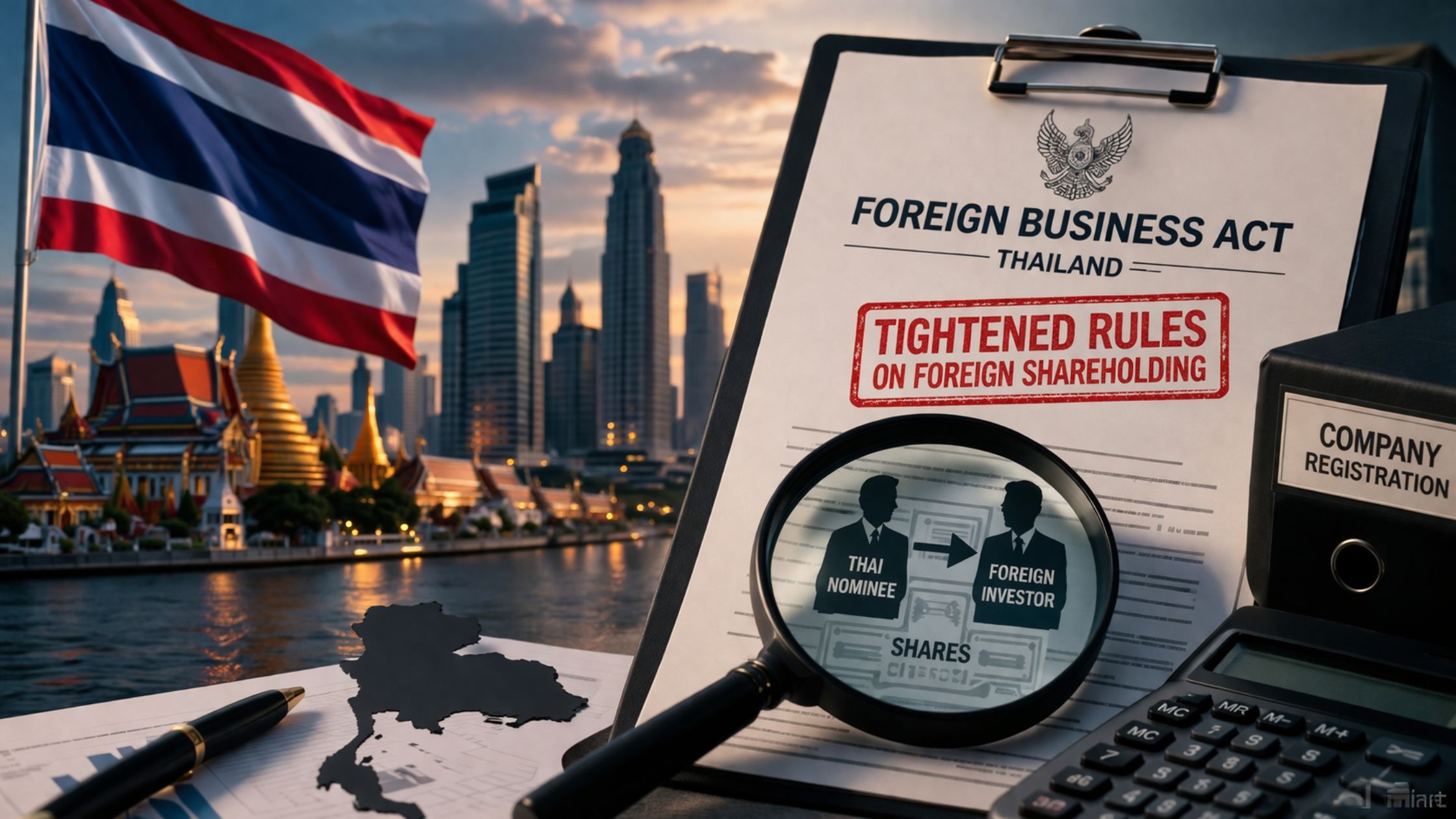
Thailand Tightens Foreign Shareholding Rules, Expands Crackdown on Nominee Structures
 by
by

New enforcement measures expected from April 2026 introduce deeper financial scrutiny, in-person verification, and data-driven oversight, marking a shift toward control-based regulation under Thailand’s Foreign Business Act.
Thailand is tightening oversight of foreign participation in domestic businesses by strengthening enforcement of existing laws rather than introducing new legislation. The Department of Business Development (DBD), under the Ministry of Commerce, is preparing a draft order expected to be issued in mid-March 2026 and potentially take effect from April 1. The measures are aimed at addressing nominee arrangements—structures in which Thai nationals hold shares on behalf of foreign investors to bypass restrictions under the Foreign Business Act (FBA).
While such arrangements have long been prohibited, enforcement has historically focused on formal indicators such as shareholding ratios. The new approach signals a shift toward examining who actually funds, controls, and benefits from a business, rather than who appears as the legal owner on paper.
What Is Changing in Practice
The tightening measures build on earlier steps introduced in January 2026 and significantly expand the level of scrutiny applied to company ownership and control. At the core of the changes is financial verification. Thai shareholders will be required to demonstrate that their investment is genuine, with authorities examining bank records and financial capacity to ensure that shareholdings are backed by real capital. This directly targets nominee structures where individuals are listed as majority shareholders without contributing funds.
In parallel, the DBD is introducing in-person verification requirements for certain corporate actions. Shareholders and directors may be required to appear before authorities, present identification, and sign formal declarations confirming that no nominee arrangement exists. This reduces reliance on proxy filings and increases accountability at the individual level.
Another key area of focus is control through management structures. Authorities are tightening scrutiny when foreigners are appointed as directors or authorised signatories, closing a common workaround where control is exercised operationally rather than through ownership.
Taken together, these measures represent a move away from document-based compliance toward a more comprehensive assessment of how businesses are actually structured and run.
Data-Driven Enforcement and Wider Investigations
The enforcement push is also being supported by expanded use of data and inter-agency coordination. Rather than reviewing companies in isolation, authorities are analysing patterns across large datasets to identify potential nominee networks.
This includes examining:
- repeated use of the same Thai individuals across multiple companies
- clusters of registrations at identical addresses
- inconsistencies between declared shareholdings and financial capacity
Authorities have already initiated reviews of tens of thousands of companies classified as “high-risk,” with particular attention on sectors such as tourism, real estate, and construction. Key economic areas, including Phuket and Pattaya, have been highlighted due to their concentration of foreign-linked business activity. The scale of these investigations suggests that regulators view nominee structures as a systemic issue rather than isolated violations.
Why Nominee Structures Persist
The continued use of nominee arrangements is closely linked to the structure of the Foreign Business Act. Under the FBA, foreign participation is restricted in a range of sectors—particularly service industries—unless investors obtain a Foreign Business Licence (FBL). In practice, securing such a licence can be time-consuming and uncertain, as authorities assess economic impact, technology transfer, and benefits to the country.
This has created an incentive for some investors to rely on informal structures that comply with ownership rules on paper but not in substance. The latest measures are designed to close this gap by aligning legal compliance with economic reality. Violations carry significant penalties, including fines of up to THB 1 million and potential imprisonment, but enforcement has historically been uneven—something the current push aims to address.
Implications for Foreign Investors
For foreign businesses, the shift marks a clear change in how compliance is assessed.
Meeting the 51% Thai ownership threshold is no longer sufficient if authorities determine that control or funding lies elsewhere. Investors will need to ensure that ownership structures reflect genuine economic participation, not just legal form.
This increases the importance of formal pathways such as:
- applying for a Foreign Business Licence
- using investment promotion schemes
- structuring operations within clearly permitted sectors
It also raises compliance risks for existing companies, as the current enforcement drive includes retrospective reviews of previously registered entities. Thai authorities have emphasized that the objective is not to deter foreign investment but to ensure that it operates within a transparent and lawful framework.
This reflects a broader balancing act. On one hand, tightening enforcement helps protect local businesses and strengthens regulatory credibility. On the other, increased scrutiny and compliance requirements may add friction for foreign investors, particularly those unfamiliar with Thailand’s regulatory landscape. How effectively Thailand manages this balance will be critical to maintaining its position as a regional investment destination.
From Formal Compliance to Economic Reality
The most significant shift is conceptual rather than legislative. Thailand is moving from a system based on formal ownership structures to one that evaluates actual control, funding, and benefit.
This “substance over form” approach aligns with a wider trend across Asia, where regulators are using data and enforcement tools to close long-standing loopholes without rewriting existing laws.
If implemented as expected, the new measures could significantly reshape how foreign investors structure their presence in Thailand—reducing reliance on informal arrangements and reinforcing the importance of transparent, compliant business models.
Thailand’s latest move signals that enforcement is becoming the primary tool for regulating foreign participation. By combining financial verification, in-person checks, and data-driven monitoring, authorities are narrowing the gap between legal ownership and operational control.
For foreign investors, the message is increasingly clear:
compliance is no longer about meeting formal thresholds—it is about demonstrating genuine ownership, transparency, and accountability.
Quick Takeaways
- Thailand is tightening enforcement of existing foreign ownership laws, targeting nominee structures rather than introducing new legislation.
- New measures include financial verification of Thai shareholders, in-person checks, and scrutiny of control structures, shifting focus from paper ownership to actual control.
- Authorities are using data analytics to identify patterns such as repeated shareholders and suspicious registrations, with reviews already covering tens of thousands of companies.
- The crackdown is concentrated in high-risk sectors like tourism and real estate, particularly in areas with high foreign business activity such as Phuket and Pattaya.
- For foreign investors, “51% Thai ownership” is no longer sufficient—compliance will depend on proving genuine capital contribution and operational control.
- The move reflects a broader shift toward “substance over form” regulation, aligning Thailand with stricter enforcement trends across Asia.